Repo ReviewAIDESIGNENGINEERING
Version-Controlling Design Taste for Agents
· 3 min read
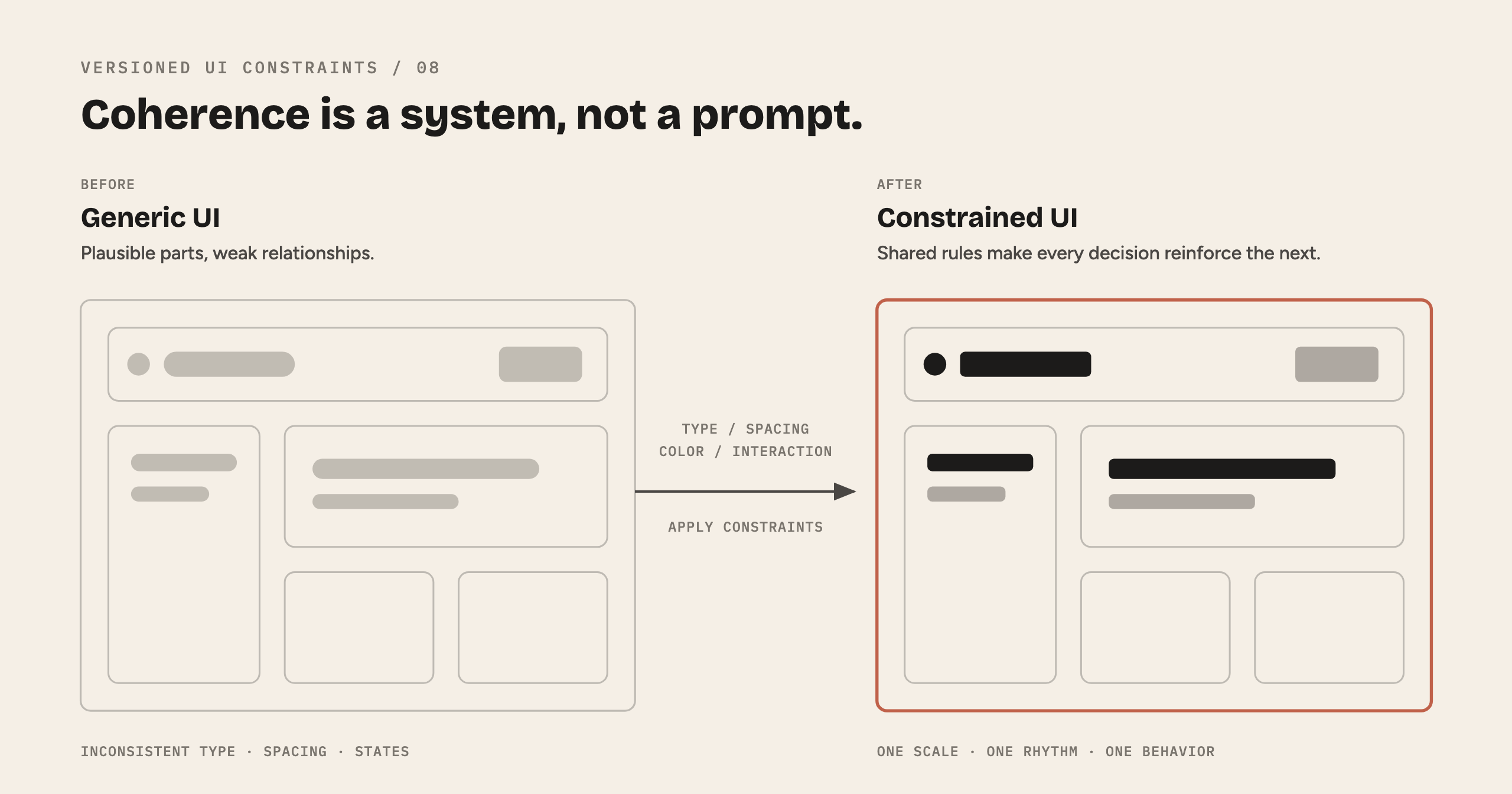
The generic-UI failure mode
Left alone, an agent generating a UI tends to produce the same recognizable baseline: functional, generic, and visually cheap. The model can render a polished interface, but a typical prompt does not define good design in terms it can apply. TypeUI treats that gap as an engineering problem: turn design principles into explicit constraints the agent can read before writing frontend code.
That changes the operator’s job. Instead of repeatedly asking an agent to “make it look better,” I can give it a shared vocabulary for typography, spacing, color, component states, and interaction behavior before generation begins.
How TypeUI works
Since this review was researched, TypeUI has expanded into a broader platform led by MCP integration, plugins, and prompt surfaces beyond its original CLI-and-Markdown workflow. The review below remains scoped to the CLI/Markdown path I inspected.
TypeUI packages design guidance for AI coding tools as Markdown. Its npx typeui.sh CLI can generate or update a local design system, create a randomized starting point, list registry entries, and pull a named specification. The output can use either SKILL.md or DESIGN.md, giving the agent project-level rules it can load alongside the codebase.
The registry makes those rules reusable. TypeUI’s list and pull commands resolve named entries to Markdown source paths, so an aesthetic such as Brutalism, Neumorphism, or Paper becomes a versioned specification rather than an adjective buried in a prompt.
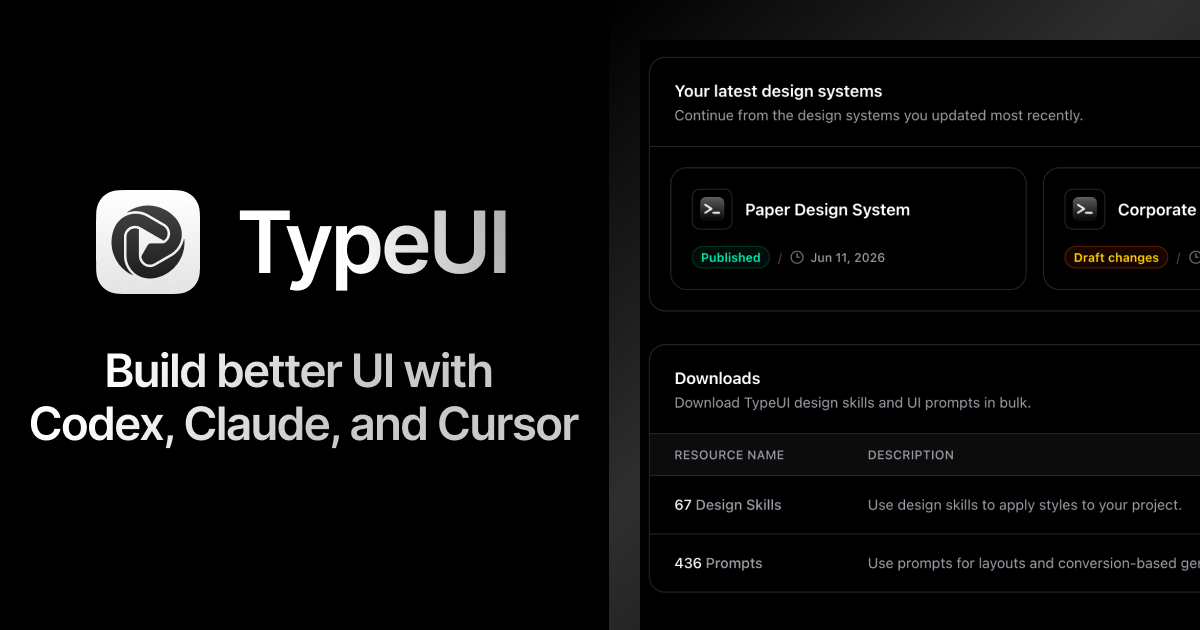
The TypeUI repository documents its CLI, registry contract, and agent-readable design guidance.
The TypeUI artifacts worth inspecting
I started with the CLI surface because it shows the workflow more clearly than the project description does. The generate, update, randomize, list, and pull commands cover both sides of the system: author a local design specification or bring an existing one into the workspace.
The registry contract is the next useful artifact. It maps each slug to a SKILL.md path and, when available, a DESIGN.md path. That small index turns a collection of design opinions into something a tool can discover and install consistently.
The Markdown files carry the real value. TypeUI’s design-system blueprint asks authors to define tokens, component states, responsive behavior, accessibility criteria, prohibited patterns, and a QA checklist. Its fundamentals skill then points the agent to deeper modules for spacing, typography, interaction, and accessibility. The accessibility guidance goes as far as testable WCAG 2.2 contrast requirements, including the familiar 4.5:1 minimum for normal text.
Why I starred TypeUI
I starred TypeUI because it moves design direction out of disposable chat history and into version-controlled project context. That is the same shift I want elsewhere in agent-assisted development: make recurring decisions inspectable, reusable, and available before the agent starts generating code.
The repo also draws a useful line between a visual style and the fundamentals underneath it. A named aesthetic can change, while rules for focus states, spacing rhythm, readable typography, and contrast remain part of the operating floor.
When I would use TypeUI
I would use TypeUI at the start of an agent-assisted interface build, especially for a prototype, a new product surface, or a marketing site without a mature design system. It gives the first generation more direction and makes later corrections easier to express as changes to shared rules rather than another round of prompt tuning.
I would also use it when several agents or sessions touch the same interface. A checked-in design file gives each run the same baseline, reducing the chance that one component adopts a different spacing scale, corner treatment, or interaction pattern from the next.
Where text constraints stop
TypeUI supplies policy, not runtime enforcement. An agent can misread a rule, implement it inconsistently, or produce a composition that satisfies every token and still feels unresolved. Contrast can be calculated; hierarchy and rhythm still need to be judged in the rendered page.
That boundary does not make the project less useful. It makes its role clearer: TypeUI raises the floor for agent-generated UI, while visual review, browser testing, and human taste decide whether the work is ready to ship.