ThoughtsAIENGINEERING
The Router I Actually Run
· 9 min read
The earlier post, "Model-Agnostic by Design," was a pitch. It laid out a routing table, some illustrative pseudocode, and a thin-adapter pattern — and said plainly, in its own text, that none of it was a production implementation or a description of a system I'd built. It was the argument for why you shouldn't wire your workflow to one provider's SDK.
This post is the receipt. delegate.sh is the thing I actually built: a single bash script, currently at v1.4.0, that fronts three model CLIs — agy for Gemini, codex for GPT, claude for Claude — behind one routing table, one sandboxing policy, and one output contract. Everything below is grounded in the real script, real tests, and a real adversarial review that happened before this shipped. Nothing here is hypothetical.
One router, three CLIs, no favorites
Any of the three CLIs can be the one driving — the interactive session you're actually typing into. delegate.sh doesn't care which. It routes work to a different CLI as a subprocess, based on a task name, not a provider preference.
The routing table used to live directly in the script as a pipe-delimited string, parsed by hand with bash's IFS='|' read. It now lives in a separate routes.json, validated once at load time by a small stdlib-only Python loader — more on why below the table:
| Task | Executor | Model | Effort | Mode | Fallback |
|---|---|---|---|---|---|
search | agy | gemini-3.1-pro | high | web | stop |
bulk | agy | gemini-3.7-flash | high | read | claude-haiku-4-5 |
cheap | agy | gemini-3.7-flash | low | read | claude-haiku-4-5 |
media | agy | gemini-3.7-flash | high | read | stop |
scaffold | agy | gemini-3.7-flash | medium | write | stop |
review | codex | gpt-5.6-sol | high | read | stop |
reason | codex | gpt-5.6-sol | high | read | stop |
audit | claude | claude-opus-4-6 | high | read | stop |
implement | codex | gpt-5.6-sol | medium | write | stop |
summarize | claude | claude-haiku-4-5 | low | read | stop |
draft | claude | claude-sonnet-5 | medium | read | stop |
(Three image-generation routes exist too, but they're not central to this.) Every model ID is pinned explicitly. Nothing here is "whatever the CLI defaults to" — a route names an exact model, and if that model gets deprecated, the fix is a one-line edit to the table, not a code change. mode sets the sandbox ceiling — read, write, or web — independent of which CLI ends up executing the task.
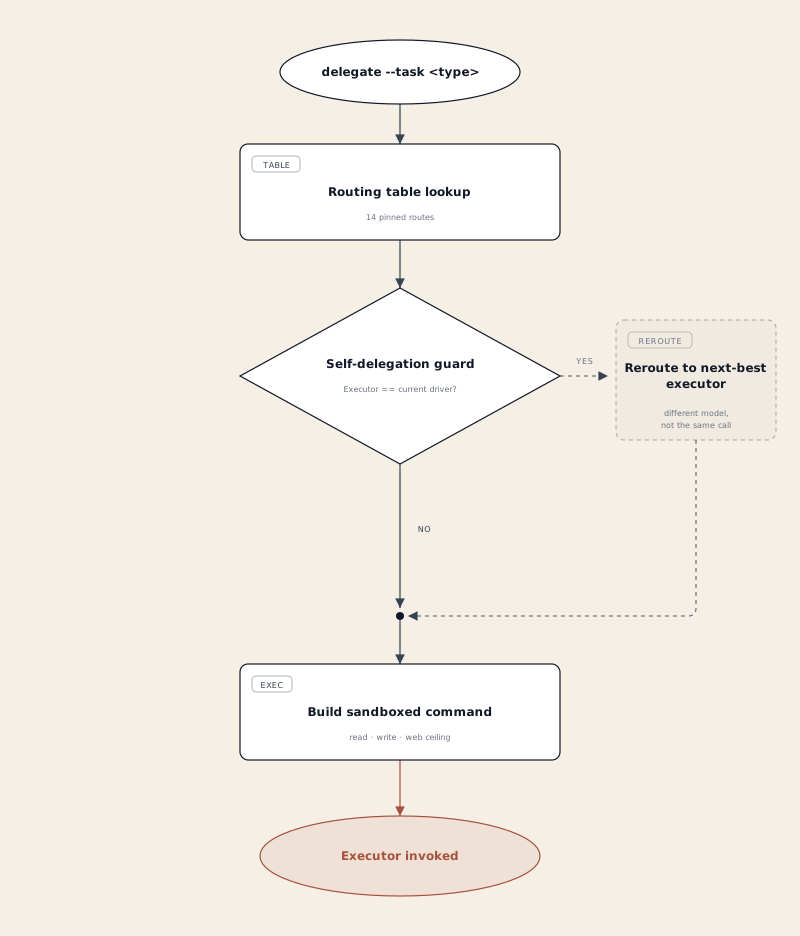
The one hard rule the router enforces: never delegate a task back to the CLI that's currently driving. If Codex is driving and calls review or reason — both normally routed to Codex — the router reroutes to Claude Opus instead. That's not a formality. It's the difference between a second, independent model actually looking at your work versus the same process quietly reviewing itself and calling it review.
Task comes in, hits the routing table, passes the self-delegation check, and only then does a command get built and executed.
A narrow fallback policy, and an envelope that always tells you why
Fallback is the part I was most conservative about, and I think that restraint is the right call. Of the eleven non-image routes, only two — bulk and cheap — have a real fallback, and both fall back to the same place: claude:claude-haiku-4-5. Everything else is stop-only.
The line I drew: tasks whose output gets consumed — a bulk read, a cheap transform — can degrade safely onto another model if the first one fails. Tasks whose output gets judged — review, reason, audit, implement, a verdict, a diff — can't. A second model silently standing in for a failed one on a judgment call isn't a convenience, it's a correctness risk you didn't sign up for.
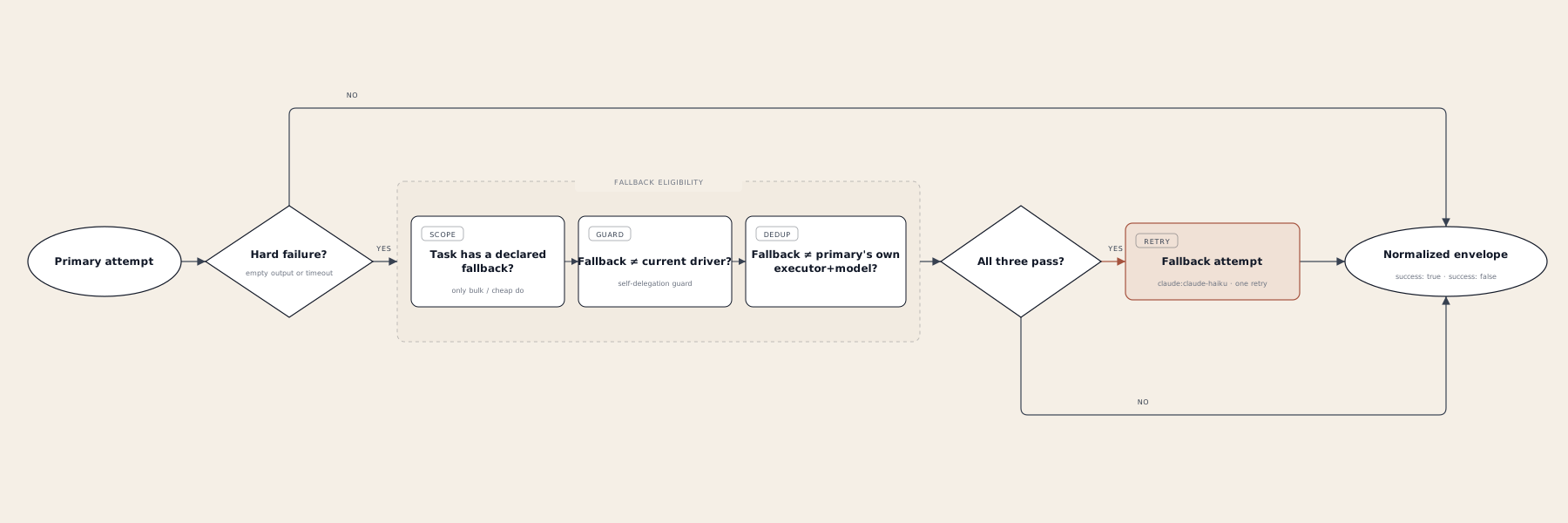
On a hard failure, an eligible task retries exactly once. It logs to stderr — falling back once to claude/claude-haiku-4-5 — never chains into a second fallback, and gets skipped straight through to the original failure if the fallback executor would just repeat the exact executor+model that already failed, or would equal whichever CLI is currently driving.
It's worth being honest about where that boundary actually lives: it's not a hard-coded guard in the code. The stop-only rule for review/reason/audit/implement sits in the exact same editable routes.json as the effort level and the model ID. Nothing stops someone from giving review a fallback, any more than it stops someone from dropping its effort to low. That's a deliberate tradeoff — one file as the single source of truth keeps the router genuinely simple — but it means the safety boundary is a convention encoded in data, not an invariant the runtime enforces against its own configuration. A careless edit can widen the blast radius and nothing will stop it. Schema validation catches a malformed row; it has no opinion on a well-formed one that quietly removes a safety boundary.
The --json flag, new in v1.3.0, is the other half of this. Every execution — success or failure — now emits the identical shape: {success, executor, model, task, duration_seconds, text, escalated_from, fallback_used, error}. Before this version, a successful call got clean structured JSON and a failed one just dumped raw stderr with nothing a caller could parse. text is null only on a genuinely hard failure — empty output, a timeout. Any nonzero exit, even one with partial output, now populates error with a short excerpt of stderr, so you can't end up with success:false, error:null. I left usage — token or cost accounting — out on purpose. None of the three CLIs expose per-call token counts on stdout today, and faking that field to make the schema look complete would've been worse than leaving it honestly absent.
Primary attempt runs, a failure gets classified, it passes through the three guard checks — stop-only, self-delegation, same-executor dedup — and either way, success or fallback or final failure, the same envelope comes out the other side.
What an adversarial review actually caught
This wasn't written and shipped — it went through a review from a genuinely independent model, a different CLI with no shared context with the one that wrote the diff, specifically hunting for bugs. It found two real blocking issues before any of this went out.
First: a task that got auto-promoted from read-only to write-mode — because its prompt asked to save a file — was keeping the fallback policy from its read-only origin. That meant a failed mutation could silently retry on a different model with edit permissions, which is exactly the one thing the fallback design exists to prevent. Fixed: auto-promotion now always drops the inherited fallback.
Second: the envelope hole I mentioned above — nonzero exit, partial output, success:false with error:null. Same fix as described.
It also caught a subtler one, worth fixing but not blocking: an existing, unrelated reroute mechanism could occasionally land the primary attempt on the exact same executor+model the fallback would also use — so on failure, the code would retry the identical call that had just failed. Fixed, with a regression test that pins it down.
Two other findings from that review got traced and deliberately left alone, not "fixed." The one worth naming: the moderation-retry mechanism applies independently to a fallback attempt too. That looked suspicious on first read, but it's intentional — a fallback call can trip moderation just as easily as a primary one, and it should get the same retry treatment, not a stripped-down version of it. Leaving an accurate finding alone is its own kind of discipline; "the reviewer flagged it" isn't a reason to change code that's already correct.
Eleven regression test groups back all of this, five of them added specifically for this change: fallback recovering a failure, a stop-only task never falling back, the self-delegation guard applying to the fallback target too, a successful primary never touching the fallback path, and the same-executor dedup case. All pass. bash -n is syntax-clean. I don't have shellcheck available in this environment, and I'd rather say that plainly than pretend the coverage is tighter than it is.
The routing table stopped being a string
One more thing changed after the review above: the routing table itself moved out of the script. It used to be a pipe-delimited string parsed inline with IFS='|' read, which meant adding a single column — the fallback field in the table above — meant updating three separate parsing sites by hand: the --list loop, the lookup function, and a hard-coded field-count assertion three lines later. Get one of those out of sync and a route fails silently or off by one field, not loudly.
It's routes.json now, and a small stdlib-only Python loader — no new dependency, python3 was already required for the JSON envelope — validates the whole table once at load time. A missing field, a wrong type, a duplicate task name: it fails immediately, naming the exact row and field, before any route gets resolved. Same routing decisions, same output contracts on both --list and a task lookup, so nothing that calls delegate.sh had to change. Two more regression tests cover the parts that actually changed: a deliberately broken table gets rejected with a specific reason, and the shipped table round-trips through both output contracts. Thirteen regression groups total now.
I thought about calling this a "hook" — Claude Code's event-triggered shell scripts — before building it, and talked myself out of it fast. A hook reacts to something already happening; this table is an explicit lookup for something about to happen on request. Wrong category for the job. The actual fix was smaller than a new primitive: stop hand-parsing a string, start validating structured data.
That's the actual state of it: one script, three CLIs, a schema-validated routing table anyone can still edit for better or worse, and a fallback policy narrow enough that I trust it. It's not a platform, and I'm not going to pretend it is. The two honest gaps are the usage field I left out because I wasn't going to fake it, and shellcheck in CI, which I just haven't wired up yet. Both are next.